Is Hemp-Derived THCA Legal? 2026 Guide
Table of Contents
- Federal Legality of Hemp-Derived THCA Under the 2018 Farm Bill
- Hemp-Derived vs. Marijuana-Derived THCA: Legal Distinctions
- THCA State-by-State Legality and Restrictions
- Understanding THCA Total THC Testing and Compliance
- Reading Your THCA Certificate of Analysis
- THCA Drug Test Risk and What You Need to Know
- Possession, Sale, and Interstate Transport Rules
- Current Legal Landscape and Enforcement
- Frequently Asked Questions
Last Updated: October 11, 2026
Federal Legality of Hemp-Derived THCA Under the 2018 Farm Bill
Hemp-derived THCA legal status depends on federal compliance: the product must contain no more than 0.3% delta-9 THC by dry weight, as defined by the 2018 Farm Bill. This landmark legislation removed hemp from the controlled substances list and created a legal pathway for hemp cultivation and derivative products.
Understanding the distinction matters because hemp-derived THCA exists in a gray zone. The federal government has not issued explicit guidance on whether THCA itself is a controlled substance or only delta-9 THC. Most legal analysis suggests that raw THCA flower complies with federal law as long as laboratory testing confirms the product meets the 0.3% limit.
The 0.3% Delta-9 THC Threshold
The 0.3% threshold is the legal ceiling for delta-9 THC content in hemp products. This percentage is measured on a dry-weight basis, meaning moisture content is removed before testing. A product can contain significant amounts of THCA and still be federally compliant if its delta-9 THC content stays below this limit.
Testing labs measure total THC differently depending on methodology. Some labs report only delta-9 THC, while others calculate total THC by adding delta-9 THC to the THCA content (after converting THCA to its THC equivalent using a standard formula).
How THCA Converts to Delta-9 THC When Heated
THCA is the raw, non-intoxicating form of THC found in fresh cannabis and hemp flowers. When exposed to heat, light, or time, THCA undergoes decarboxylation, a chemical process that removes a carboxyl group and converts THCA into delta-9 THC. Smoking or vaping THCA flower triggers this conversion almost instantly, delivering psychoactive effects similar to traditional cannabis.
This conversion mechanism creates a legal ambiguity. Federal law regulates delta-9 THC, not THCA itself. A raw THCA flower product may be federally compliant in its unheated state but becomes a controlled substance once decarboxylated.
Hemp-Derived vs. Marijuana-Derived THCA: Legal Distinctions
The source of THCA matters significantly for legal status. Hemp-derived THCA comes from plants cultivated under the 2018 Farm Bill framework, with documented lineage to compliant hemp genetics.
Even if two THCA products are chemically identical, their legal status depends entirely on their source plant. A product labeled "hemp-derived" should include documentation proving the plant met federal hemp standards at cultivation.
This distinction also affects interstate transport and retail sales. Hemp-derived THCA products can theoretically be shipped across state lines under federal law (though state-level restrictions may apply). Marijuana-derived THCA cannot cross state lines legally under any circumstances.
THCA State-by-State Legality and Restrictions
State laws vary dramatically on THCA flower and smokable hemp products. Some states explicitly permit hemp-derived THCA products, others have banned them outright, and many occupy a legal gray zone with no specific guidance. The legal landscape changed significantly in 2024 and 2025, with several states introducing new restrictions.
THCa Flower Legal (For Now?!) Cannabis Lawyer Reacts | THCa hemp Flower Legal Issues
Cannabis Legalization News
States Where THCA Flower and Smokable Hemp Are Permitted
States that have not explicitly banned THCA products generally recognize hemp-derived THCA legal under their hemp regulations. These include states where hemp-derived products are legal if they meet federal THC thresholds. However, "permitted" does not always mean "clearly legal", many states simply have not addressed THCA specifically, leaving retailers and consumers in legal uncertainty.
Permitted states typically require laboratory testing and compliance documentation. Products must display certificates of analysis (COAs) proving compliance with the 0.3% delta-9 THC limit. Some states require additional licensing or registration for retailers selling hemp-derived products.
States With Explicit THCA Bans or Restrictions
Several states have moved to restrict or ban THCA products entirely, treating them as cannabis products subject to state licensing requirements. These bans typically apply to THCA flower and smokable hemp products, sometimes extending to THCA concentrates and edibles.
Restrictions vary in scope. Some states ban THCA flower but allow other hemp-derived products. Others require THCA products to be sold through licensed cannabis retailers only. A few states have criminalized possession or sale of THCA products regardless of source or potency.
The legal status in any given state can change rapidly. Legislation introduced in 2025 and 2026 has shifted the landscape, with more states moving toward restriction.
Understanding THCA Total THC Testing and Compliance
Laboratory testing is the foundation of legal THCA compliance. Products must be tested by accredited labs using standardized methodologies. However, testing standards vary, and how labs calculate and report results affects legal compliance determinations.
How Total THC and Post-Decarboxylation Calculations Work
Total THC is calculated by adding the delta-9 THC content to the THCA content after converting THCA to its THC equivalent. The conversion uses a standard formula: multiply THCA percentage by 0.877 (the molecular weight ratio).
Some labs report only delta-9 THC, while others report both delta-9 and total THC. This distinction is critical for compliance. The U.S. Department of Agriculture's hemp testing guidelines specify that compliance should be measured by total THC content, though enforcement varies by state and federal agency.
Post-decarboxylation calculations estimate how much delta-9 THC a product would contain after heating. These projections help regulators assess whether a product would exceed legal limits if consumed.
Reading Your THCA Certificate of Analysis
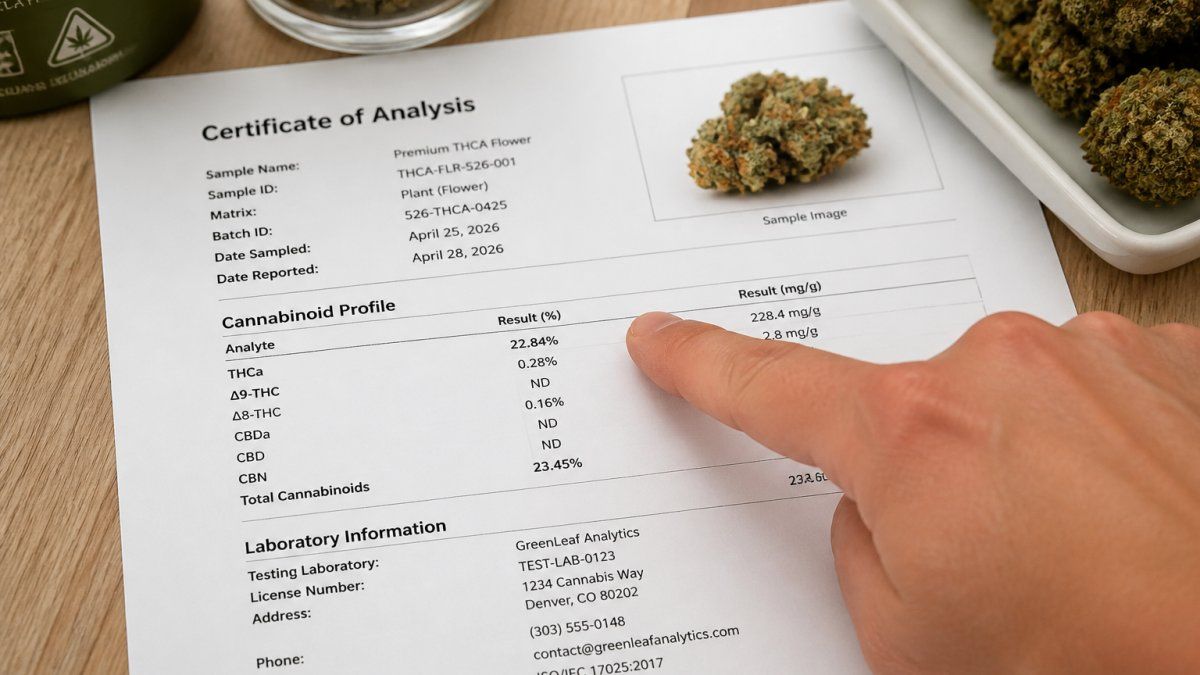
A certificate of analysis(COA) is a laboratory report documenting the cannabinoid profile and purity of a THCA product. Reputable retailers should provide a COA with every purchase. Understanding how to read and interpret this document is essential for assessing compliance and product quality.
What to Look For on a COA
A valid COA should include the lab's name, accreditation status, and the date of testing. It must specify the testing methodology and report results for delta-9 THC, THCA, and ideally total THC.
Look for the delta-9 THC percentage first. It should be clearly stated and should not exceed 0.3% for federally compliant hemp products. Check the THCA percentage and verify that the lab has calculated total THC.
The COA should also include testing for contaminants like pesticides, heavy metals, and microbial pathogens. Reputable labs test for these substances and report results. If a COA omits contaminant testing or shows failed results, the product may pose health risks.
THCA Drug Test Risk and What You Need to Know
THCA converts to delta-9 THC when heated, which means consuming THCA products can result in a positive drug test for THC. Standard urine and saliva tests detect delta-9 THC metabolites, and these tests cannot distinguish between THC from hemp-derived THCA and THC from marijuana.
If you consume THCA flower or vape THCA concentrates, THC will enter your bloodstream and appear on drug screening tests. Employers and other testing entities typically do not distinguish between hemp-derived and marijuana-derived THC.
Hair tests may detect THC for longer periods than urine tests. Blood tests can show THC presence but typically cannot determine the source.
Possession, Sale, and Interstate Transport Rules
Federal law permits possession and sale of hemp-derived products that comply with the 0.3% delta-9 THC threshold. However, state laws create significant restrictions.
Interstate transport of hemp-derived THCA products is theoretically permitted under federal law, as the 2018 Farm Bill allows interstate commerce in compliant hemp products specifies. However, state border enforcement and varying state definitions of legality create practical barriers.
Retail sale of THCA products is legal in states that permit hemp-derived products but may require licensing or compliance with additional regulations. Some states require retailers to register with state authorities or meet specific labeling and testing standards.
Current Legal Landscape and Enforcement
The legal status of hemp-derived THCA remains unsettled as of 2026.
The Drug Enforcement Administration has not published explicit guidance on THCA scheduling, leaving interpretation to state authorities and lower-level federal enforcement decisions.
State enforcement has intensified in 2025 and 2026, with several states moving to restrict or ban THCA products.
The pending potential federal rescheduling of cannabis and derivatives could affect THCA's legal status, though the timeline and scope remain uncertain.
At Tree Haus Cannabis Boutique, we stay current with evolving THCA regulations and ensure that all products comply with federal standards and current state law.
The legal status of hemp-derived THCA is complex and changing.
Frequently Asked Questions
Is hemp-derived THCA legal under federal law?
Yes, hemp-derived THCA is federally legal if it complies with the 2018 Farm Bill, which defines legal hemp as cannabis containing no more than 0.3% delta-9 THC by dry weight. THCA itself is not a controlled substance, but when heated, it converts to delta-9 THC. Products must meet the 0.3% threshold to remain federally compliant. However, state laws vary significantly, so always verify your state's specific regulations before purchasing or possessing THCA products.
Will hemp-derived THCA show up on a drug test?
Yes, hemp-derived THCA can produce a positive result on a standard drug test. Most drug tests detect delta-9 THC metabolites, and since THCA converts to delta-9 THC when heated (including in your body during digestion or smoking), it can trigger a positive result. If you are subject to drug testing for employment, legal, or athletic reasons, consuming THCA products carries real risk. This applies even if the product is federally compliant. Consider this risk before using THCA products if regular testing is part of your situation.
What should I check on a THCA certificate of analysis?
A certificate of analysis (COA) should clearly show total cannabinoid content, including THCA percentage and delta-9 THC percentage. Verify that delta-9 THC is at or below 0.3% by dry weight to confirm federal compliance. Check the lab's accreditation and the test date to ensure results are recent. Look for testing of contaminants such as pesticides, heavy metals, and microbial pathogens. Cross-reference the batch number on your product with the COA to confirm it matches. Request a COA from any retailer if one is not provided.
Is THCA legal in every state?
No. While hemp-derived THCA is federally legal, many states have enacted their own bans or restrictions. Some states explicitly prohibit THCA flower and smokable hemp products, while others allow them. State restrictions vary widely and change frequently. Before purchasing or possessing THCA products, check your state's current cannabis and hemp regulations or consult your state's attorney general office for the most up-to-date legal status. State rules can differ from federal law, and state restrictions take precedence within that state's borders.
Can I travel with hemp-derived THCA products?
Traveling with THCA products is legally risky and not recommended. Although federal law permits hemp-derived THCA that meets the 0.3% threshold, many states prohibit it, and crossing state lines with THCA can expose you to state-level criminal charges. TSA (Transportation Security Administration) does not permit cannabis or THCA on flights, regardless of federal hemp legality. Local law enforcement may not distinguish between federally compliant hemp-derived THCA and illegal cannabis. If you travel, leave THCA products at home and verify the destination state's laws before considering transport.
How do states determine whether a THCA product is legal?
States use several approaches: some apply the federal 0.3% delta-9 THC threshold, others ban THCA explicitly regardless of THC content, and some regulate THCA as cannabis subject to state licensing. A few states calculate total THC by adding THCA's potential delta-9 yield (post-decarboxylation) to existing delta-9, which can make compliant hemp products illegal under state law. Regulatory frameworks differ significantly by state, and some state laws remain ambiguous or are still evolving. Check your state's hemp or cannabis agency website, or contact a local attorney familiar with cannabis law for clarity on your state's specific approach.
What is the difference between hemp-derived and marijuana-derived THCA?
The legal distinction hinges on delta-9 THC content at harvest. Hemp-derived THCA comes from plants containing 0.3% delta-9 THC or less by dry weight, making it federally legal under the 2018 Farm Bill. Marijuana-derived THCA comes from plants exceeding that threshold and is controlled under federal law. Both convert to delta-9 THC when heated, but only hemp-derived products can legally cross state lines under federal law. State laws, however, may treat both sources the same way or ban THCA from either source entirely. The source matters for federal compliance, but state rules ultimately determine legality where you live.